
The 432 528 Theorists are a group of 12 musical scales created by 8 thinkers, brought together by Toni Mazzotti in the free online application called 432 528 Tunings (see here). Each of them, in their own way, considers these numbers to be structural and universal. And most of the proposals have traditional musical applications.
Bringing together the main alternative musical theories that include or are anchored in the frequencies 432 Hz and 528 Hz is essential to support the discussion about updating the global Reference Frequency standard.
Download all Tuning Scripts here.
Summary of Theorists

Robert Grant, bestselling author in mathematics and geometry, and one of today’s most prominent advocates of 432 Hz, with the 24-note PTT system that includes both 432 Hz and 528 Hz.
Maria Renold, musicologist who worked closely with Rudolf Steiner and developed two tuning systems inspired by his ideas, now among the most widely used in the 432 Hz community.
Shannon DeBie, exploring exact numerical relationships to create mathematically stable musical intervals.
Robert Comber, with 72 notes per octave, offering higher microtonal resolution for astrological and harmonic correspondence analysis.
Bo Constantinsen, with the sequence of “the sacred numbers,” considered highly significant in mathematics, geometry and cosmology, and associated with therapeutic and spiritual properties.
Ananda Bosman, with one of the simplest and most versatile adaptations, promoting the use of 432 Hz while preserving Equal Temperament.
Shu Zaiyu, the creator of Equal Temperament, presented here in 440 Hz to support tuning comparisons.
Toni Mazzotti, with two original systems: the Torus Triplets, based on the 18 triplet number combinations emerging from the three toroidal orbit positions, popularized in recent decades as healing frequencies; and the Spiral Tuning 144-EDS (coming soon).
432 528 Tunings
Below you will find a complete overview of each proposal, including a detailed explanation of its tuning method, followed by a brief biography of its creator. Each section also includes its main characteristics and strengths, along with links to references, research materials and downloadable resources.
The numbers or symbols shown in parentheses at the beginning of each name indicate the keyboard shortcuts assigned to that tuning within the online application.
(1) Precise Temperament Tuning 432 by Robert Grant (12-PTT – 2020)

The musical scale Precise Temperament Tuning (PTT), created by Robert Grant, is a well temperament system that proposes adjusting the major third from 1.25 to 1.26, while keeping the major second, perfect fourth, and perfect fifth intact. With this, it reconciles Just Intonation with Equal Temperament in a system created for 432 Hz.
Just Intonation has mathematical perfection in the major second, perfect fourth, and perfect fifth, but does not allow transposition. Equal Temperament allows modulation between keys, but lacks precision in the fifth. PTT, on the other hand, has mathematical perfection in both: the major second, perfect fifth, and perfect fourth.
The reference frequency 432.081216 Hz, arises from multiplying 216 by 1.26 three times. The number 216 is associated with the geometric base of the Tetraktys, present in ancient traditions. The factor 1.26 is an expansion of the major third, which is 1.25. By replacing 1.25 with 1.26, the whole scale reorganises.
This same value (1.26) corresponds to the cube root of 2, the solution to the classical mathematical problem of duplicating the cube. Applied to music, it allows the exact duplication of the musical octave. These numbers were identified by Robert in the Vitruvian Man, by Leonardo da Vinci, with 126 in the corner of the page and the circle measuring 4.32 inches. The Codex Atlanticus documents Leonardo’s passage through Egypt around 1486. Thus, 1.26 solves the problem of duplicating the cube and also of duplicating the octave.
As a consequence of replacing 1.25 with 1.26, all notes create a “blockchain-style” decimal extension, where all new frequencies sum to 9 naturally, as do the angular sums. In the article “Precise Geometrical Correspondence to the Perfect 5th Tuned to the 432 Hz Frequency”, Robert shows how the 12 notes of the octave have inherent decimal references that correspond precisely to the internal angles of regular polygonal shapes that exhibit symmetries found in nature. This exact correspondence manifests only when the tuning is set to 432 Hz instead of 440 Hz.
Robert Grant is an entrepreneur, inventor, and best-selling author in mathematics and geometry, with significant contributions to medical technology, clean energy, social media, cryptography, physics, chemistry, and music. His work is characterised by an approach that seeks to unify science, art, philosophy, and spirituality. He is also a prominent presenter in series and documentaries on ancient civilisations, promoting expeditions around the world.
Grant offers books, online courses, lectures, and digital content, combining education, exploration, and both in-person and virtual experiences. In Philomath (2021), his best-known work, Robert Grant and Talal Ghannam propose an integration of numbers and geometry as a unifying foundation for the sciences, exploring connections between physics, fundamental constants, music, geometry, and number theory.
▶︎ Precise Temperament Tuning 432 by Robert Grant (12-PTT – 2020)
- It is a musical tuning system developed for a 432 Hz reference.
- It is a 12-note well temperament system with closed octaves (2:1).
- It is considered a midpoint between the precision of Just Intonation and the versatility of Equal Temperament.
- Many notes generate decimal expansions that reflect the same values present in the main frequencies.
- It exhibits near-complete geometric angular sums (mod 9) across all frequencies.
- It is compatible with broad harmonic practice (polyphony and modulation).
- It is fully compatible with MIDI mapping on controller keyboards.
- PTT stands for Precise Temperament Tuning.
▶︎ Reference Links
- Robert Grant – Official Site
- Precise Temperament Tuning – Home Page
- Precise Temperament Tuning – PDF with details
- How to create and use the 432 Hz Precise Temperament scale files – Start Guide
- See and hear the differences between Equal Temperament, Precise, Just and Pythagorean at 432 Hz – Music comparisons
- Precise Temperament Tuning 432 by Robert Grant (12-PTT – 2020) – Tuning Scripts
(2) Precise Temperament Tuning 528 by Robert Grant (12-PTT – 2023)
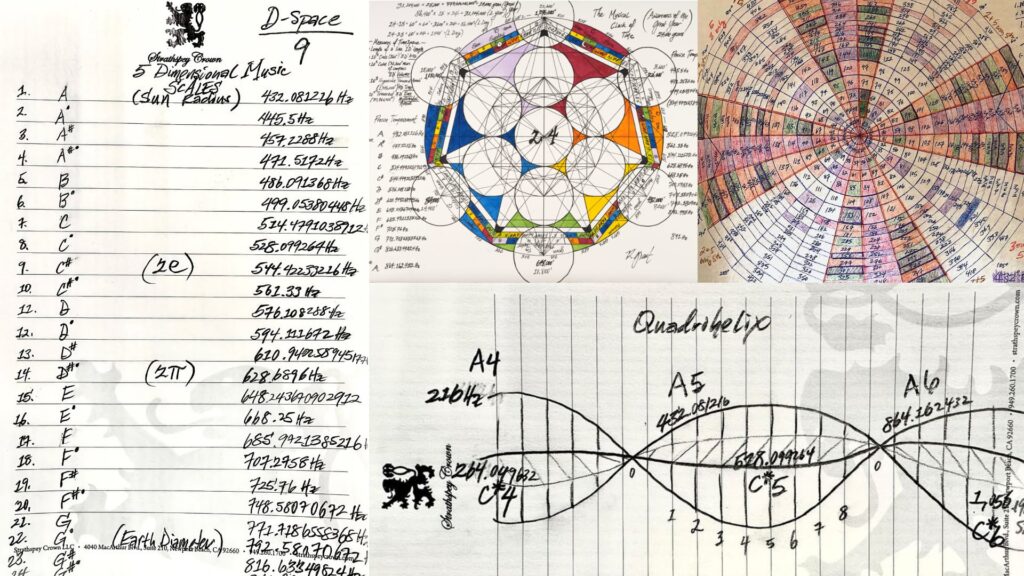
The musical scale Precise Temperament Tuning 528, created by Robert Grant, features the 12 secondary notes of the 24 quarter-tone scale tuned to 432 Hz. It was the third scale to include 528 Hz as one of its notes, and the first to use this frequency in a context compatible with Western harmony (see more on the 12-PTT 432 and 24-PTT 432 528 scales).
The implementation of this version with only 12 tones at 528 Hz allows the exclusive use of odd tone positions, making their physical mapping compatible with MIDI controller keyboards and maintaining full playability (polyphony and transposition). When using this scale, the A4 pitch should be set to 445.5 Hz. This is a consequence of the exclusive use of these intermediate frequencies in controllers with only 12 notes per octave.
Precise Temperament Tuning 528 by Robert Grant (12-PTT – 2023)
- It is a tuning created for 432 Hz, present in the 24 quarter-tone version.
- It is considered a well temperament system with closed octaves (2:1).
- It exhibits perfect geometric angular sums (mod 9) in almost all frequencies.
- It is associated with the ratio of 432 to 528, rediscovered on the Giza Plateau in Egypt.
- It was the first scale to include 528 Hz within a Western harmonic context.
- It is compatible with broad harmonic practice (polyphony and modulation).
- It allows the exclusive use of the 12 notes at 528 Hz, contained within the 24-tone version of the scale tuned to 432 Hz.
- It is compatible with MIDI mapping on controller keyboards.
- PTT stands for Precise Temperament Tuning.
▶︎ Reference Links
- Robert Grant – Official Site
- The Musical Wave of Time – Audiovisual Album on YouTube
- Precise Temperament Tuning 528 by Robert Grant – Tuning Scripts
(3) Precise Temperament Tuning 432 528 by Robert Grant (24-PTT – 2023)
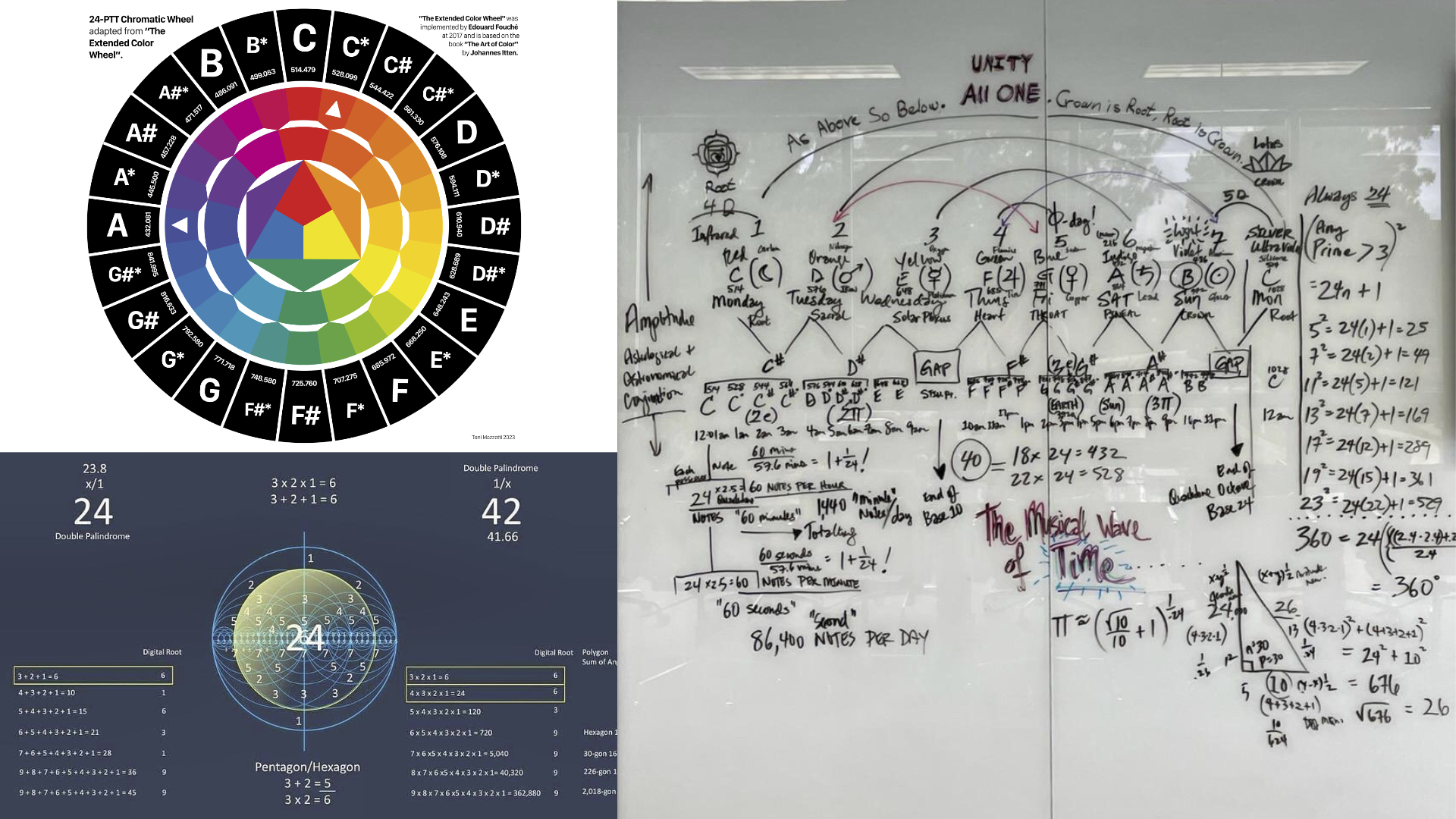
The musical tuning Precise Temperament Tuning with 24 notes, created by Robert Grant, is the result of his scientific knowledge applied during his investigations of historical temples around the world. It opens a new chapter in the debate between the 432 Hz and 528 Hz communities, which had previously been considered oppositional.
While analysing the Giza Plateau in Egypt, Robert discovered that its proportions correspond exactly to 432 and 528. Considering the popularity of the number 528 in the healing community, he decided to apply the PTT method at 528 Hz, deriving a second 12-note musical scale that fits precisely within the 12-note scale tuned to 432 Hz. This led to the creation of a cosmological 24-note quarter-tone scale, which contains, simultaneously, 432 Hz as its reference frequency and 528 Hz as one of its quarter-tone intervals.
The formulation called The Musical Wave of Time, developed by Robert Grant, relates the seven musical notes, the seven primary colours, the seven days of the week, and the seven chakras, expanding our perception of the relationship between the 24 hours of the day, the 24 secondary colours, and the 24 quarter-tones in music.
Some of the most sophisticated musical traditions divide the octave into 24 notes, although they continue to use only five to seven per composition. This expands the number of possible functional chords from about 800 to more than 16,000, which can then be distributed across the 24 hours of the day, creating a type of repertoire that indicates to musicians the thematic and the chords for each hour. By using 24 notes, it becomes possible to align harmonic structures with time measurement, significantly deepening the relationship between musical expression and cosmology.
▶︎ Precise Temperament Tuning 432 528 by Robert Grant (24-PTT – 2023)
- It is a scale developed from a 432 Hz reference.
- The division of the octave into 24 quarter-tones, through the PTT method, naturally results in the inclusion of a note at 528 Hz.
- It is associated with the ratio of 432 to 528, rediscovered on the Giza Plateau, Egypt.
- It presents an intricate correlation between the 24 musical notes and the hours of the day, colours, and chakras.
- It exhibits near-complete geometric angular sums (mod 9) across most.
- It was the third musical scale to consider 528 Hz as a musical note, introduced in 2023.
- It was the first scale to include 528 Hz within a Western harmonic context.
- It is compatible with broad harmonic practice (polyphony and modulation).
- It enables harmonisation between 432 Hz and 528 Hz within a single system.
- It is not natively compatible with standard MIDI mapping on controller keyboards.
- PTT stands for Precise Temperament Tuning.
▶︎ Reference Links
- Robert Grant – Official Site
- How to make music with the 432 Hz and 528 Hz tunings – Post
- The Musical Wave of Time – 24 Chakra Tones by Toni Mazzotti – Post
- The Musical Wave of Time – Audiovisual Album on YouTube
- Precise Temperament Tuning 432 528 by Robert Grant (24-PTT – 2023) – Tuning Scripts
(4) Twelve Fifths 432 by Maria Renold (12-TEM – 1962)
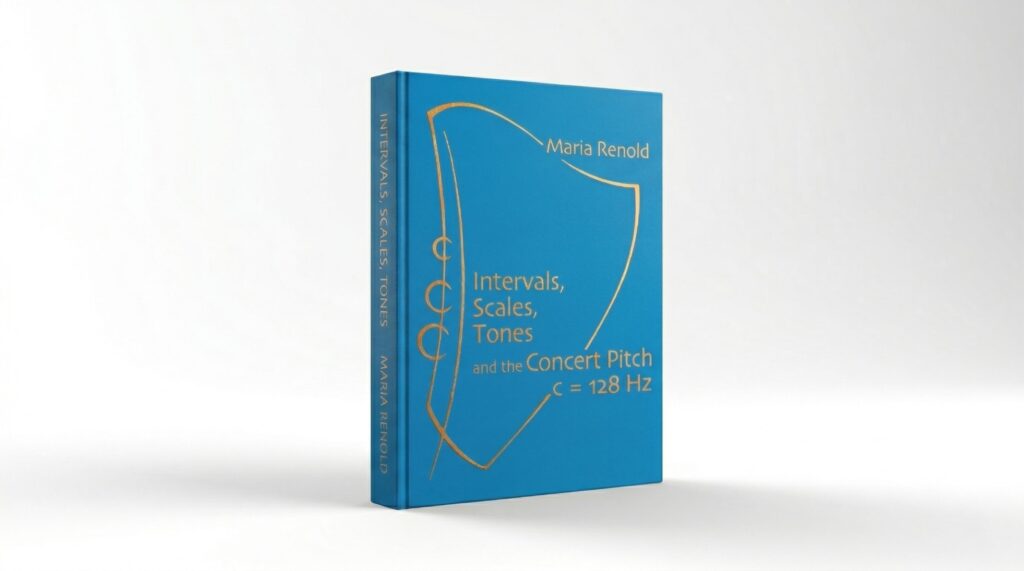
The musical tuning Twelve Fifths 432 by Maria Renold (1964) is an expanded Pythagorean scale, constructed from two sequences of pure fifths, one on the white keys and another on the black keys, connected by two adjusted intervals. It is based on Philosophical C (128 Hz, 256 Hz…), which, when the pure fifths are maintained, results exactly in a reference frequency of 432 Hz. It was presented in the book “Intervals, Scales, Tones and the Concert Pitch C = 128 Hz”, published in German in 1984.
Her pioneering work is the result of 25 years of research and experimentation. It begins with a critique of Equal Temperament, which breaks the natural perceptual coherence between intervals, especially the fifths. In this context, the experience of playing a string instrument together with a piano can be disturbing. The piano has fixed notes and uses tempered tuning (compressed fifths), while the violin is tuned in perfect fifths, and at each chord the violinist must move their fingers to adjust intonation, following the slight detunings of the piano’s temperament. This motivated her to seek a solution.
Starting from the Pythagorean scale of C, which has seven notes, a new tone is inserted in the middle of each whole tone, defined as the geometric mean of the two corresponding extreme frequencies. This creates five additional semitones (black keys), placed exactly between the whole tones, named Delis, Elis, Gelis, Alis, and Belis, resulting in a chromatic scale of 12 tones within a closed octave (2:1).
This method tunes the piano to string instruments and, starting from Philosophical C (128 Hz), results exactly in a concert pitch of 432 Hz. For this reason, the author considers this scale superior to any other tuning system.
Renold’s research also demonstrated that small variations in the frequency of a tone give rise to different qualities. She concluded that the concert pitch itself plays an important role in musical tuning. She conducted experiments with four tones in eight variations: two Cs and two As, in different octaves, tuned at 440 Hz and 432 Hz. Using the notes A1 (108 Hz), C2 (128 Hz), C4 (256 Hz), and A4 (432 Hz), and their variations tuned at 440 Hz: A1 (110 Hz), C2 (130.813 Hz), C4 (261.626 Hz), and A4 (440 Hz).
Out of 2,000 people tested over 20 years in the United States, Italy, Germany, and Switzerland, more than 90% consistently preferred the notes tuned to 432 Hz. Notes tuned to 440 Hz were described as stressful and overstimulating, while the same notes at 432 Hz were perceived as comfortable and natural: “The results were extraordinarily interesting and unequivocal. I do not know of any group test in which people preferred 440,” wrote Maria Renold.
Renold emphasises that the scale was initially discovered experimentally by ear and only 20 years later confirmed theoretically. In 1518, Henricus Grammateus was the first to calculate this scale through the geometric division of a monochord.
Maria Renold (1917–2003) was a German-American violinist, concert violist, musicologist, and a follower of the ideas of Rudolf Steiner. With roots in Anthroposophy and Eurythmy, at the age of six she moved with her family to New York, where her mother became the first Eurythmy teacher in North America, trained by Rudolf and Marie Steiner themselves.
She researched musical tuning for 25 years and wrote the book “Intervals, Scales, Tones and the Concert Pitch C = 128 Hz”, which became a modern classic in musical research. She further developed Steiner’s spiritual-scientific research, elucidating his statements on music. When she learned of his suggestion of C at 128 Hz, she immediately put it into practice and experimented with it for 20 years across America and Europe.
In her book, Renold named the concert pitch proposed by Steiner (C = 128 Hz) as “Philosophic C”, also known as Scientific Pitch: “Music based on C = 128 Hz (C note in concert A = 432 Hz) will support humanity on its way towards spiritual freedom. The inner ear of the human being is built on C = 128 Hz” — Rudolf Steiner.
She discovered a method of tuning the piano that is closer to string instruments, starting from Philosophic C and reaching exactly 432 Hz as the reference frequency. She tested more than 2,000 people over 20 years, with 90% preferring tones (Cs and As) tuned to 432 Hz.
For Maria Renold, Equal Temperament is antisocial, and the standard reference frequency of 440 Hz contributes to the high stress levels of our time.
She passed away on February 21, 2003.
▶︎ Twelve Fifths 432 by Maria Renold (12-TEM – 1962)
- It is a 12-note well temperament system with closed octaves (2:1).
- It is an expansion of the 7-note diatonic Pythagorean scale into a 12-note chromatic version.
- It maintains two groups of perfect fifths (7 white keys and 5 black keys) totaling 10 pure fifths, while the remaining 2 divide the comma (B – F#) and (A# – F).
- Renold was a follower of the ideas of Rudolf Steiner, referring to her indication of C at 128 Hz as “Philosophical C”: “Music based on C = 128 Hz will support humanity on its way towards spiritual freedom. The inner ear of the human being is built on C = 128 Hz.”
- Tuning C to 128 Hz results exactly in A at 432 Hz when pure (Pythagorean) fifths are used.
- Renold tested more than 2,000 people over 20 years, with 90% preferring tones (Cs and As) tuned to 432 Hz.
- The standard pitch of 440 Hz increases stress levels in our time, according to Renold.
- Her book, published in 1985, became a modern classic in musical research.
- It is compatible with broad harmonic practice (polyphony and modulation).
- It is compatible with MIDI mapping on controller keyboards.
- TEM stands for Temperament.
▶︎ Reference Links
- Intervals, Scales, Tones: And the Concert Pitch C = 128 Hz – Book
- Twelve Fifths 432 by Maria Renold (12-TEM – 1962) – Tuning Scripts
(5) Middle Tuning 432 by Maria Renold (144-TEM – 2006)
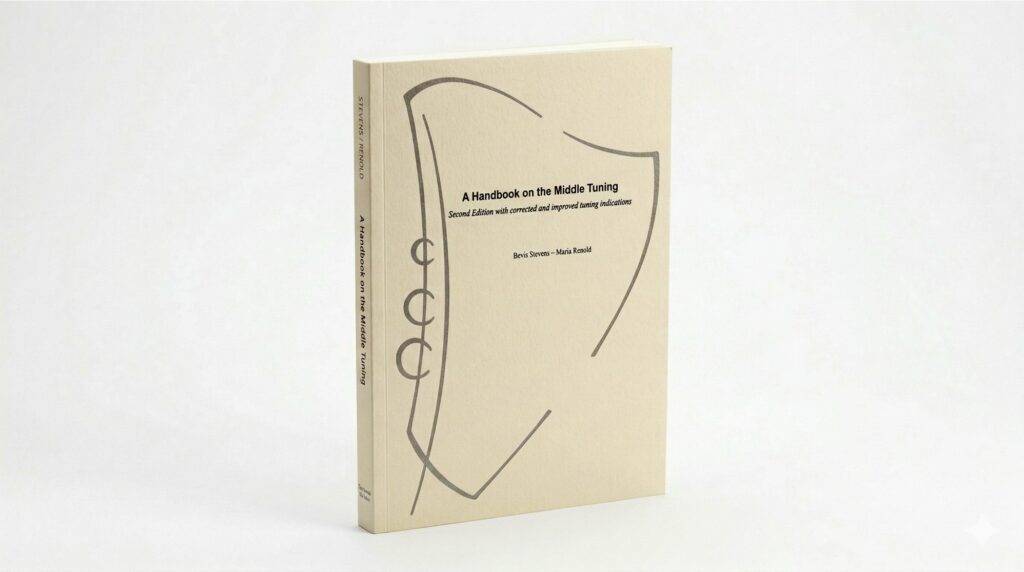
The musical scale Middle Tuning 432 by Maria Renold (2006), also known as Renold 2, is an open system with octaves slightly larger than doubles. It was presented by Bevis Stevens in the book “A Handbook on the Middle Tuning” in 2006, with revisions in 2013.
It is an enhancement of the Renold 1 scale (Twelve Fifths, 1964), made possible by two new discoveries: that the octave has two sizes, with the genuine octave being slightly larger than the traditional octave; and that there are three sizes of perfect fifths.
As a string player, Renold perceived a problem when playing together with the piano using the double-octave flageolet, a very pure harmonic of the violin. String instruments follow exact proportions of the harmonic series, while the piano in Equal Temperament uses slightly altered intervals, causing the higher notes to sound out of tune between the two instruments.
In the case of the open Middle Tuning system, the octave ratio is 2.003873819, equivalent to 1203.35 cents. The consequence can be visualised not as a circle, but as a growing spiral of 88 different tones on the piano (not equivalent by exact octave).
Tuning the piano with open octaves (stretch tuning) has long been an established practice in musical performance, making the piano more compatible with string instruments in orchestras. This compensates for the physical inharmonicity of the piano, but also reveals the original spiral character of musical tuning.
▶︎ Middle Tuning 432 by Maria Renold (144-TEM – 2006)
- It is a 12-note well temperament system with open octaves (not 2:1).
- It presents early proposals of “open octaves” and different sizes of perfect fifths.
- It is constructed from the geometric mean of the expanded octave (1203.35 cents).
- It presents 88 “distinct” chromatic notes on the piano.
- Stretch Tuning is the most commonly used method for tuning acoustic concert pianos, because inharmonicity, but also because, in an instrument that contains all melodic octaves, the spiral of harmonics is revealed.
- It is compatible with broad harmonic practice (polyphony and modulation).
- It is compatible with MIDI mapping on controller keyboards.
- TEM stands for Temperament (a term used whenever any fifth in the system differs from a pure fifth).
▶︎ Reference Links
- Middle Tuning 432 by Maria Renold (144-TEM – 2006) – Tuning Scripts
(6) Harmonics One 432 by Shannon de Bie (12-TEM – 2025)
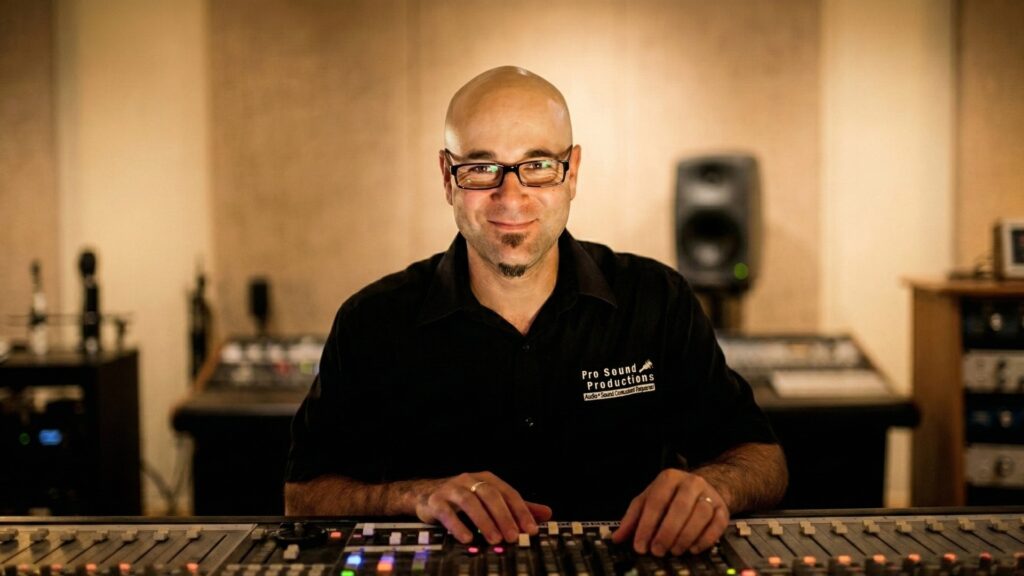
The musical tuning Harmonics One by Shannon de Bie, derives frequencies directly from natural harmonic relationships. The origin of the idea lies in the attempt to reorganise music based on the harmonic series and fundamental mathematical proportions, treating sound as a geometric, vibrational, and also biological phenomenon.
It is based on internal proportional structures derived from integer multiples of the fundamental frequency of 432 Hz, approximating Just Intonation and Pythagorean tuning, but with its own approach that also integrates concepts of resonance and biofrequency. The value of 432 Hz does not arise automatically from the mathematical structure, but is adopted as a point of alignment, as it is considered more coherent with harmonic patterns and the biological resonance models used by the author. Thus, the harmonic series defines the structure of the system, while 432 Hz defines its absolute calibration.
In comparison with Equal Temperament, the semitones vary between approximately 90 and 110 cents. The intervals sound purer than in 12-EDO, but with instabilities in polyphony and chord modulation across all keys. It acts as a bridge between the pure harmonic series and a manageable number of degrees (12) per octave, allowing the exploration of natural sonorities without requiring complex systems with 31 or 43 notes, for example.
It also proposes that time and pitch share the same nature. Hertz ceases to be only a unit of tuning and becomes understood as a universal unit of oscillation, connecting pulse, rhythm, and pitch within the same continuous domain.
Shannon de Bie is an Australian musician, researcher, and developer focused on alternative tuning, sound geometry, and harmonic systems based on 432 Hz. He serves as president of the Pro Sound Foundation and director of the NOW-SOUND, dedicated to the exploration of new musical structures. He was the first to tune an acoustic piano in Precise Temperament Tuning at 432 Hz and 528 Hz. He is the creator of the Harmonics One 432 system, which seeks to organise music based on mathematical proportions and natural resonance. His work investigates the relationship between sound, geometry, and human perception, positioning him as an emerging figure in the field of new approaches to musical tuning.
▶︎ Harmonics One 432 by Shannon de Bie (12-TEM – 2025)
- It is a 12-note tempered system with closed octaves (2:1).
- It is inspired by natural harmonic relationships.
- It prioritises important natural intervals within a practical 12-note system.
- All frequencies are rational multiples of 432 Hz.
- It departs from 12-TET and preserves more direct harmonic proportions at specific points in the scale.
- In comparison with Equal Temperament, the semitones vary between approximately 90 and 110 cents.
- It is semi compatible with broad harmonic practice (polyphony and modulation).
- It is compatible with MIDI mapping on controller keyboards.
- TEM stands for Temperament.
▶︎ Reference Links
- NOW-SOUND Foundation – Website
- Harmonics One 432 by Shannon de Bie (12-TEM – 2025) – Tuning Scripts
(7) The Lost Octave 432 528 by Robert Comber (72-TEM – 2023)

The musical tuning The Lost Octave by Robert Comber is a concept that integrates the I Ching, astrology, and sacred geometry, with music functioning as a connecting language between them. The starting point is the expansion of the traditional system of 64 hexagrams of the I Ching into 72 Gates.
The central proposal is that there is a “lost octave” in the way many esoteric and symbolic systems have been organised and transmitted. This expansion restores structural completeness, suggesting that the model of 64 does not close a complete cycle. The 72 Gates form an expanded matrix that allows the correlation of archetypes, astrological cycles, and human patterns, including parallels with genetic structures and processes of consciousness, acting as a point of convergence between different types of cycles and subdivisions, aligning the natural relationship between time, celestial bodies, and music.
It is a high-resolution harmonic microtonal scale, allowing the creation of musical chords related to up to 72 microdivisions of the octave, achieving a high level of relational analysis with the astrological chart. The high density of notes per octave fully maps an 88-key keyboard, using just over one octave of the scale.
The Lost Octave is an applied cosmology, where the expansion to 72 represents the transition from a model that describes the world to one that seeks to transform how one navigates within it. It also includes the so-called “Quadrinity Psychology”, which organises personality patterns into four elements and their combinations, transforming symbolic interpretation into a relational reading and offering a broader tool for understanding human experience.
Each gate is associated with patterns that can be related to astrology, allowing a more detailed interpretation of astrological charts. The system establishes parallels with biological structures, suggesting correspondences between these symbolic patterns and the human genetic code. Music appears as the connecting element between these domains, functioning as a language capable of expressing proportions, relationships, and transitions between levels of organisation.
Robert Comber is the creator of the concept and author of the book The Lost Octave, in which he presents the expanded model of the 72 Gates. His work combines elements of the I Ching, astrology, sacred geometry, and studies of consciousness. His system unifies different ancient traditions within an expanded structure, with a focus on the interpretation of human and cosmological patterns. His work is primarily disseminated through the book and online materials.
▶︎ The Lost Octave 432 528 by Robert Comber (72-TEM – 2022)
- It is a microtonal system designed for astrological analysis.
- It allows very high microtonal resolution and detailed subdivision of intervals.
- It consists of 864 notes across 12 octaves, with 72 notes in each closed octave (2:1).
- It has low playability on standard MIDI keyboard controllers due to the high density of notes per octave.
- TEM stands for Temperament.
▶︎ Reference Links
- The Lost Octave – Website
- The Lost Octave – Book on Amazon
- The Lost Octave 432 528 by Robert Comber (72-TEM – 2023) – Tuning Scripts
(8) The Sacred Sounds 432 528 by Bo Constantinsen (33 notes – 2015)

The musical scale The Sacred Sounds by Bo Constantinsen, integrates the reference frequencies 432 Hz, 440 Hz, and 528 Hz, among others. The coexistence of these reference frequencies is a direct consequence of this structure, in which they appear as harmonic steps belonging to the same family of internal relationships.
It consists of 32 tones derived from the harmonic series between 32 and 64, based on a fundamental frequency of 8 Hz. In addition to these, there is one extra tone, totaling 33 tones. The reference tone is 256 Hz, known as Scientific Pitch and the frequency of 528 Hz is the second step of the next double (above 512), as the series continues naturally in steps of 8: 528, 544, 560, and so on.
This scale allows musicians and sound therapists to explore a variety of frequencies that are often associated with therapeutic and spiritual properties.
Bo Constantinsen is a spiritual seeker and discoverer of free energy. He is developing a series of content titled “What Music Really Is”, which is intended to be: “The Manual for the Musician of the 3rd Millennium.” It is a musical treatise that addresses acoustics, harmonic theory, and everything related to music in simple language, without using concepts or terminology from any established musical culture, functioning as a scientific and mystical knowledge base on the science of music. Constantinsen offers music production services for special and avant-garde projects and dedicates his time to the development of this manual.
▶︎ The Sacred Sounds 432 528 by Bo Constantinsen (33 notes – 2015)
- It consists of 33 frequencies from the harmonic series of 8 Hz (32 to 64).
- It treats 8 Hz as a recurring reference point, connected to brainwaves and the Schumann resonance.
- It integrates the reference frequencies 256 Hz, 432 Hz, 440 Hz, and 528 Hz into a single scale.
- 528 is the second step above 512: 520, 528, 544, 560…
- It allows musicians and sound therapists to explore frequencies considered sacred.
- It critiques the 12-note scale, the closed octave, the irregular keyboard, the five-line staff, inherited note names, and cents as historical technologies to be surpassed.
- It is an experimental microtonal scale.
- It is not compatible with broad harmonic practice (polyphony and transposition).
- It is not structured around traditional octaves.
▶︎ Reference Links
- What Music Really Is – Website
- Learn to Hear the Dissonances of Equal Temperament – Online Course
- The Sacred Sounds 432 528 by Bo Constantinsen (33 notes – 2015) – Tuning Scripts
(9) Toroidal Triplets 528 by Toni Mazzotti (18 notes – 2026)

The musical scale Toroidal Triplets 528 by Toni Mazzotti, was created to educate the use of these numbers as musical frequencies. Today, there are five scales that include 528 Hz as one of their notes: those of Leonard Horowitz (1999/2008), Bo Constantinsen (2015), Robert Grant (2023), Robert Comber (2024), and Toni Mazzotti (2026). The scales of Horowitz, Constantinsen, and Mazzotti are considered Experimental Microtonal Scales because they do not form traditional harmonic chords, whereas the scales of Grant and Comber are considered Harmonic Microtonal Scales.
If arranged into three columns, the digital roots of the natural numbers repeat in the triplet groups [1, 4, 7], [2, 5, 8], and [3, 6, 9]. These patterns appear in various ancient traditions as expressions of numerical and cosmological organisation. By expanding all six permutations of the three triplets, we obtain 18 possible combinations.
These 18 numbers can be understood as cyclical trajectories in a discrete toroidal space, but not as physical frequency values. From the perspective of music theory and acoustics, the chord combinations formed from notes derived from these triplets and their permutations do not create harmonic relationships, do not exhibit traditional octaves, and do not allow modulation.
In recent years, this symbolism has gained significant popularity on digital platforms, especially on YouTube, in content that directly associates triplet numbers with specific frequencies (such as 396 Hz, 528 Hz, or 963 Hz) and with mental states such as relaxation, healing, or deep sleep.
▶︎ Triplets Timeline 147 258 369
The triplets have a concrete mathematical origin in the Luo Shu of ancient China, are formally explainable through modular arithmetic developed in modern mathematics, and have only recently been interpreted as flows or toroidal structures.
1000 bC – China
The first documented occurrence of triplets appears in ancient China, in the so-called Luo Shu, a 3×3 magic square dated approximately between 1000 BC and 200 BC. In this mathematical and cosmological system, the numbers from 1 to 9 are arranged so that all rows, columns, and diagonals sum to 15. This matrix reveals three distinct numerical cycles when observed modularly: 1→4→7→1, 2→5→8→2, and 3→6→9→3.
500 bC – India
In ancient India, the foundations of modular arithmetic (mod 9) and numerical cycles emerge, later developing further in the Islamic world.
1600 – Europe
Modern mathematics arises with number theory and modular congruence (mod 3). In 1801, with the work of Carl Friedrich Gauss, modular arithmetic begins to be treated rigorously. Within this context, these groupings can be understood as equivalence classes in modulo 3 or modulo 9 systems.
1900 – Nikola Tesla
Tesla is said to have related energy, frequency, and number to the triplets 3, 6, and 9, respectively. However, there is no scientific documentation confirming that he developed a formal system based on these numbers.
1980 – Joseph Puleo
Puleo claims to have rediscovered numerical patterns in ancient biblical texts, especially in the Book of Numbers. Using Pythagorean numerology and digital reduction, he derived six central frequencies: 396, 417, 528, 639, 741, and 852 Hz. These were named the Solfeggio Frequencies and were later reinterpreted by various contemporary authors. This marks the first explicit attempt to connect numerical triplets to sound frequencies.
1990 – Marko Rodin
Rodin develops the concept of Vortex Mathematics, organising cycles into three families of triplets with distinct structural functions. In this model, the set 1–2–4–8–7–5 forms a closed loop, while 3–6 appear as an oscillating axis and 9 as a central point. At this stage, triplets begin to be interpreted as flows rather than static groupings. Although the diagram contains only nine numbers, Rodin states that it has 18 steps to complete a cycle, with nine on each side.
1999 – Leonard Horowitz
Horowitz promotes Puleo’s ideas. Together, they co-authored the book Healing Codes for the Biological Apocalypse (1999), which presents the first musical scale using the frequencies 396, 417, 528, 639, 741, and 852 Hz. In 2008, this was expanded to nine notes, including the triplets 174, 285, and 963. The central point of this approach is the frequency 528 Hz, referred to as the “Love Frequency” or “DNA Repair Frequency.” According to this proposal, 528 Hz is associated with the helical structure of DNA, molecular coherence, and biological regeneration.
2000 – Torus
The structure of the triplets begins to be reinterpreted through a geometric perspective, especially associated with the toroidal topology. In this view, 1–4–7 and 2–5–8 are seen as flows moving across the surface of a closed system, while 3–6–9 functions as an axis or equilibrium point. Thus, triplets are not only numerical groupings but also flow lines (loops) that move through toroidal space according to a rule of continuous transformation. Each triplet defines an independent orbit, and together the three orbits cover the entire structure. Individual numbers can be interpreted as positions in a cyclic space, and permutations as different possible paths within it. A torus is considered a geometric model close to a self-sustaining oscillator, where energy does not dissipate but transforms. Many traditions describe the Earth’s energy field, the human heart field, and even galactic structures as toroidal.
2018 – Robert Grant
Robert Grant discovers Mod24, which reveals hidden properties of triplets and their permutations, relating them respectively to gravity, electromagnetism, and matter. This discovery helped him explore the long-standing problem of prime number predictability, relevant to global data cryptography. It also underlies the 24-note version of Precise Temperament Tuning. Notably, Grant had his initial insights into Mod24 after spending a night alone inside the Great Pyramid of Giza.
2026 – Toni Mazzotti
Toni Mazzotti creates a microtonal musical scale based on the 18 triplets for educational purposes, in which each number represents a point in toroidal space rather than a frequency in hertz. In this system, these ideas are not directly copied from any specific tradition but emerge as natural properties of periodic structures, especially when modelled on continuous surfaces such as the torus. The intention is to demonstrate the impracticality of using multiple triplets simultaneously for traditional harmonic music creation.
▶︎ Reference Links
- Toni Mazzotti – YouTube channel
- Toroidal Triplets 528 by Toni Mazzotti (18 notes – 2026) – Tuning Scripts
(-) Equal Temperament 432 by Ananda Bosman (12-TET – 1999)
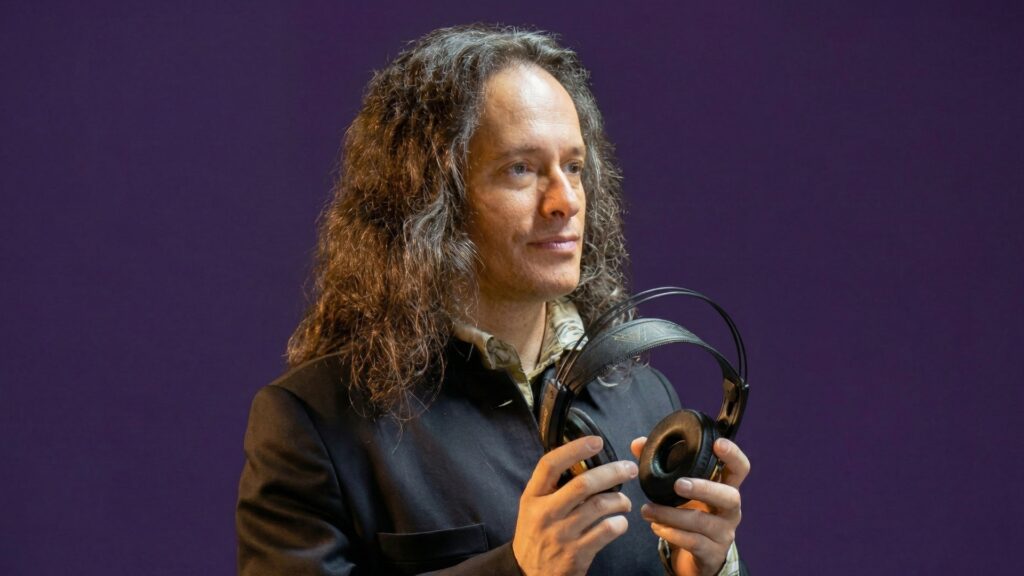
The tuning of Equal Temperament down to 432 Hz, proposed by Ananda Bosman, is the simplest and most compatible way to tune to 432 Hz. This approach seeks to minimise the effects of Equal Temperament by bringing its frequencies closer to the notes of Philosophic C and Scientific Pitch (Cs at 128 Hz, 256 Hz…), making the sonic experience more integrated with the human body, without altering the intervallic distances.
It is the most compatible option because it shifts all notes equally without introducing microtonality, making it the only viable solution for fixed-temperament instruments such as guitars, samplers, some analogue synthesisers, and older virtual instruments. By lowering the reference frequency by 31.77 cents, from A4 = 440 Hz to A4 = 432 Hz, while maintaining the equal division of the closed octave (2:1), most notes differ by approximately 1–2 Hz from the Pythagorean scale. It is therefore the preferred method for many bands performing live, as it provides greater stability in melodic music with frequent key changes and does not require microtonal guitars with independently adjustable frets.
Ananda began his work with 432 Hz in 1994, influenced by Jonathan Tennenbaum. He promotes the AUMega movement, which combines 432 Hz with rhythms at 72, 108, and 144 beats per minute, and also incorporates 8 Hz, associated with states of coherence and perceptual integration. His music production and mastering process, known as UFOM (Unified Field Overall Mastering), organises all sonic elements—frequencies, rhythms, timbres, and instrumental density—to achieve greater coherence, clarity, and harmony. He explores musical styles such as trance, ambient, and meditative music.
Ananda Bosman is a composer, writer, researcher, and lecturer who positions himself as a visionary scientist, integrating art, science, spirituality, and technology into a unique approach. He has an extensive body of work, including texts, magazines, and publications, with more than 10 books and over 100 articles addressing themes such as consciousness, sacred geometry, cosmology, and multidimensional realities. He also works as an international speaker, having presented his ideas in more than 20 countries, articulating science, shamanism, mythology, cosmology, and states of consciousness to propose an integrated view of reality. His main contribution lies in his attempt to establish a new musical language based on universal harmonic principles, especially tuning at 432 Hz, associated with 8 Hz and rhythmic structures linked to natural cycles at 72, 108, and 144 beats per minute.
▶︎ Equal Temperament 432 by Ananda Bosman (12-EDO – 1999)
- It is a system of 12 equal divisions of the closed octave (2:1).
- It is the easiest and most compatible method for tuning instruments to 432 Hz.
- It is the only method compatible with fixed-temperament instruments.
- It preserves the polyphonic versatility of Equal Temperament while bringing frequencies closer to Philosophic C and Scientific Pitch.
- It is the most compatible tuning in Western music (polyphony and modulation).
- It is fully compatible with MIDI mapping on controller keyboards.
- TET stands for Equal Division of the Octave.
▶︎ Reference Links
- Ananda Bosman – Website
- Ananda Bosman – Books on Amazon
- Ananda Bosman – Soundcloud
(+) Equal Temperament 440 by Zhu Zaiyu (12-TET – 1584)

The 12-tone Equal Temperament tuning (12-TET) was first mathematically formalised in 1584 by Zhu Zaiyu in China. As there was no demand for polyphony, the system remained largely theoretical. In Europe, its development occurred independently, driven by the evolution of polyphony, which required modulation between tonalities.
Equal Temperament became established between the 18th and 19th centuries as a practical necessity, enabling the development of Baroque, Classical, and Romantic music. It became the standard mainly due to convenience and portability. Retuning instruments for different systems was impractical, and many instruments do not allow flexible adjustments. In fretted instruments, Equal Temperament avoids tuning conflicts between strings. With the emergence of mass-produced concert pianos and, later, the introduction of the MIDI protocol, Equal Temperament gradually became the global standard.
It imposes sonic equivalence across all tonalities. This eliminates natural hierarchies and weakens clear tonal identities present in earlier systems, resulting in music that is more flexible but less connected to physical acoustics. It is a limited system, developed for a specific historical context and consolidated for technological, pedagogical, and industrial reasons.
Despite its known limitations, it has been considered the best compromise compared to other systems, which overly favoured certain tonalities at the expense of others. It compromises fundamental intervals such as fifths and fourths, which are no longer pure, leading to debates about which intervals are most affected: some authors point to the fifths (Maria Renold), while others highlight the thirds as the most affected (Hermann von Helmholtz).
Until then, tuning was treated as an art, varying according to the tuner, but with this method it became a scientific process, standardised and reproducible anywhere.
Zhu Zaiyu, a prince of the Ming dynasty (1536–1611), is today recognised as a figure of great scientific and cultural importance and is widely considered the first to mathematically solve the problem of 12-note Equal Temperament. His work is valued as a fundamental milestone in the history of music theory. There is a memorial dedicated to him in Henan province (Qinyang), known as the Zhu Zaiyu Memorial, which houses exhibitions about his life and work, as well as musical instruments and documentary records of his contributions.
▶︎ Equal Temperament 440 by Zhu Zaiyu (12-EDO – 1584)
- It is the reference system used to define microtonality.
- It standardised the global musical system together with the reference frequency A = 440 Hz.
- It facilitates the construction, tuning, and standardisation of instruments.
- It is the scale most compatible with broad polyphony, transposition, and free modulation, due to its equal intervals.
- It resolves the comma by distributing the error evenly across the 12 intervals.
- No interval is fully consonant, but none is sufficiently inaccurate to be rejected.
- It is fully compatible with MIDI mapping on controller keyboards.
- TET stands for Twelve-tone Equal Temperament.
▶︎ Reference Links
- Equal Temperament – Wikipedia
- Zhu Zaiyu memorial – Wikimedia
Your Help Is Welcome
What I consolidate today in this project is the result of the fusion of two lifelong paths. First, a long and in-depth immersion in musical composition and analysis, studies in acoustics and sound physics, advanced research in tuning systems and microtonality, and comparative historical investigation of traditions such as the Greek, Chinese, and Indian systems. Second, my passion for — and professional experience of more than two decades in — multiple multimedia languages, including programming, design, audio, video, and music.
This study is still in development and may contain errors. Feel free to contribute by suggesting improvements. And feel free to share and replicate the information contained in my work.
Please keep the credits of all those involved.
Free Educational App
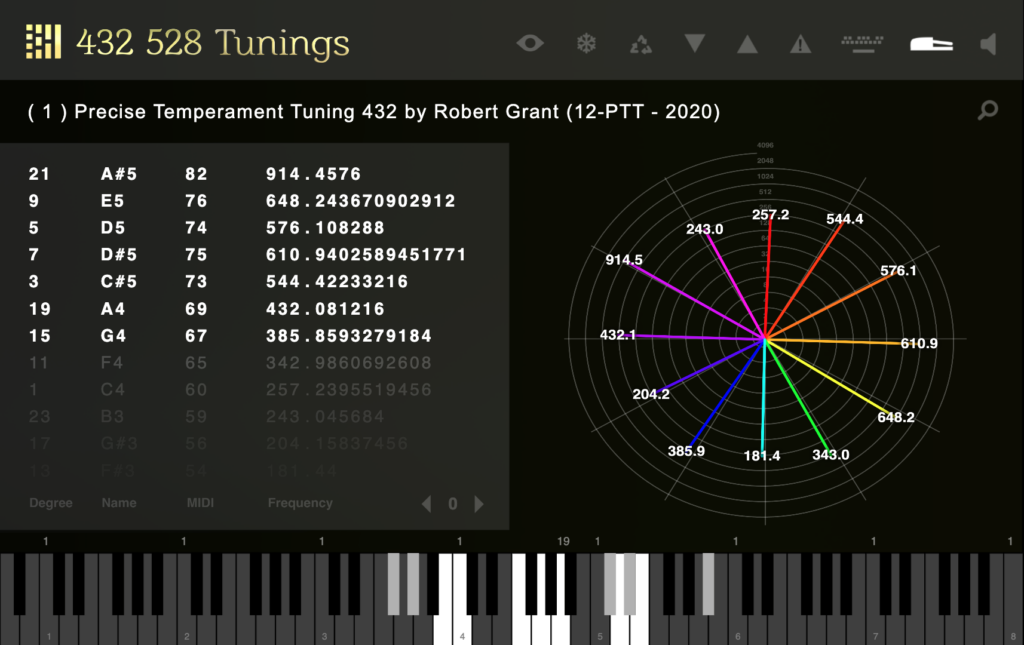
To understand the importance of these tuning alternatives, it is necessary to bring the different proposals together within a clear and consistent framework. To make this possible, I created an app that allows visual and sonic comparisons, which we will use throughout this course.
432 528 Tunings is a free online educational application that tunes instruments, converts audio and compares the main alternative musical tunings. Learn more.
Credits
Research and resources by Toni Mazzotti
Tunings and Scales by Robert Grant, Maria Renold, Shannon de Bie, Robert Comber, Bo Constantinsen, Toni Mazzotti, Ananda Bosman and Shu Zaiyu.