
“The sensation of performing in large choirs or orchestras
is often described as spiritual or even mystical...“
Shimmer is a psychoacoustic phenomenon produced by the interaction between monophonic sound sources in unison. Such as two or more singers or violins playing the same note at the same time. It creates a sense of shimmer, depth, and movement that, until now, had not been fully understood.
While investigating the 24-PTT frequencies, in 2026 Robert E. Grant discovered a hidden numerical relationship that transforms the structural error inherent in musical temperaments into a uniform temporal modulation.
24-PTT Dual-Track Shimmer is generated from a microscopic secondary layer positioned only 0.3254 cents above the original notes. Too small to be perceived as a separate pitch, yet large enough to create an angelic, luminous quality that causes tones to breathe. Unlike historical Shimmer techniques, the exact relationship is derived from arithmetic, with 23.45 millicents. Two virtually identical notes separated by only a fraction of a cent.
Acoustic instruments with multiple oscillators for the same note, such as choirs, string ensembles, gamelan, piano, organs celeste, musette accordions, and double-reed harmoniums, naturally produce some degree of Shimmer. Dual-Track Shimmer extends and controls this principle deliberately, making it possible to reproduce it in virtual instruments of any timbre.
What’s new about
Dual-Track Shimmer?
Traditional Shimmer arises from the natural interaction between two or more independent sound sources performing in unison..
Dual-Track Shimmer arises from the deliberate, precise microscopic tuning of a second version of each note.
This discovery helps explain the immersive experience musicians describe when performing in orchestras, or that singers experience in a live choir, where many people sustain the same notes simultaneously. It is also why a violin section sounds more alive than a single perfectly tuned violin: the richness emerges precisely from the presence of these microscopic variations. (See research papers at the end of this article.)
“Shimmer is what emerges between notes when harmonic
relationships become so coherent that the
structure itself becomes alive.”
– Robert E. Grant
Resolution of Historical
Tuning Problems
For thousands of years, tuning systems try to eliminate errors. In 24-PTT Shimmer, rather than treating this as a defect, it becomes the very source of life within the harmonic system.
The values that optimize Shimmer emerge naturally from 24-PTT, which is anchored at A = 432.081216 Hz, with its secondary track at 528.099 Hz. These frequencies are not chosen arbitrarily, but arise from mathematically exact relationships.
By raising the major third to the rational ratio 1.26, while keeping the fifth pure, the system dissolves the comma at closure and carries, within its reference pitch, a ninth-digit architecture that defines its own harmonic sequence: Lá–Mi–Lá. The small residue left by the rational third 1.263, exceeding the octave by approximately one-third of a hundredth of a semitone, is not a defect, but a second structure: Double-Track Shimmer, in which every note carries two frequencies separated by a constant 0.3254 cents, sounding together as a single tone that breathes.
The result is a mathematically coherent solution that simultaneously preserves interval purity, reconciles historical compromises, enables unrestricted modulation, and retains the harmonic residue as a single exact rational quantity.
This discovery may shift the focus of tuning theory from the analysis of isolated intervals to the coherence of the system as a whole. In this framework, the traditional problem of the commas ceases to be a tuning defect and instead becomes an inherent harmonic characteristic. From this perspective, the pentatonic, diatonic, chromatic, just, and Pythagorean scales are not competing musical truths, but different navigational paths through the same recursive harmonic landscape.
This framework is a strong candidate for a universal harmonic structure, in which the world’s principal musical scales can be understood as subsets of a single recursive lattice. Within this structure, geometry, number theory, psychoacoustics, and musical harmony converge toward a unified mathematical description of music.
Biology and Consciousness
The frequencies of the 432 Hz and 528 Hz + Shimmer scales bridge sound and DNA, facilitating biological resonance and the evolution of consciousness. Their gentle modulation creates a state of harmonic coherence within the listener’s biofield, synchronizing cellular oscillations and promoting repair and regeneration.
– Promotes synchronization between the heart’s and brain’s waveforms;
– Enhances emotional regulation and cognitive clarity;
– Stimulates dormant DNA strands and genetic memory;
– Facilitates the release of oxytocin, serotonin, and other well-being neurochemicals;
– Induces a non-linear auditory experience that functions as a harmonic portal;
– Catalyzes transformation, creativity, and latent potential;
– Mirrors the Monad Spiral, reflecting the process of spiritual awakening.
“Time to awaken Harmonic Memory.”
– Robert E. Grant
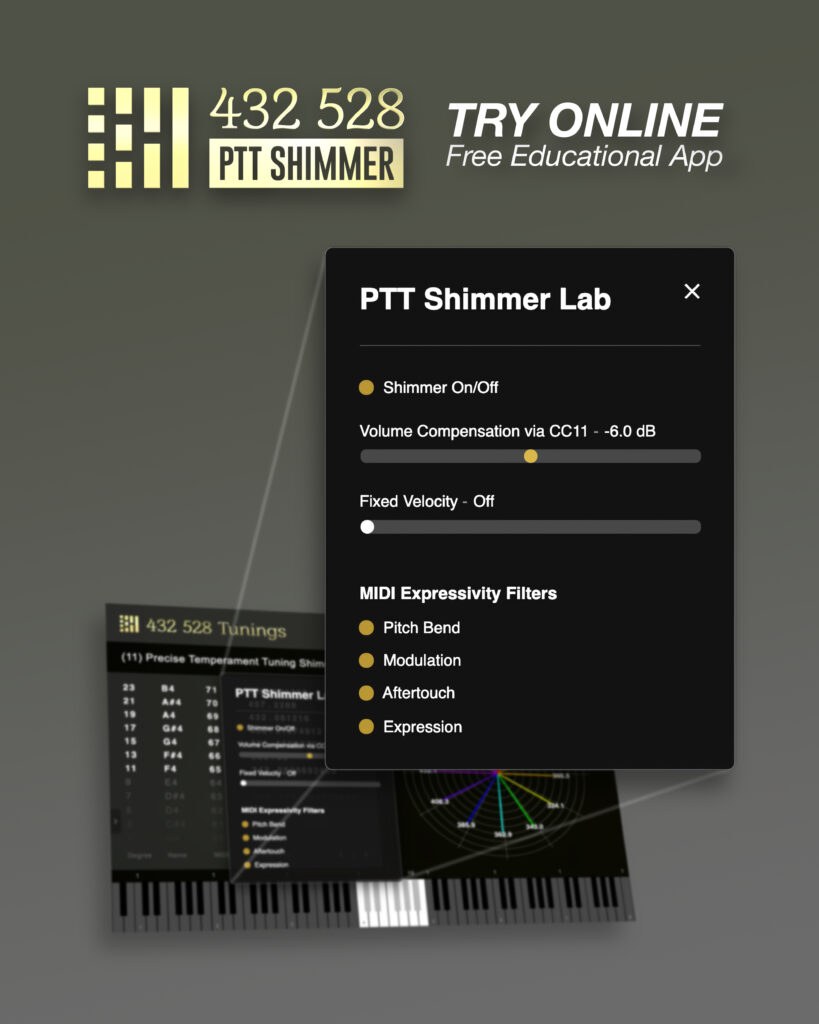
Play Shimmer Online
On the free educational application 432 528 Tunings.
This new 2026 discovery expands the tuning systems proposed by Robert E Grant from 3 to 6. It also increases the total number of proposals included in the online educational application, created by Toni Mazzotti, where the 3 new tunings can be found and tested:
- ( 11 ) Precise Temperament Tuning Shimmer 432 by Robert Grant (12-PTTS – 2026)
- ( 12 ) Precise Temperament Tuning Shimmer 528 (12-PTTS – 2026)
- ( 13 ) Precise Temperament Tuning Shimmer 432 528 (24-PTTS – 2026)
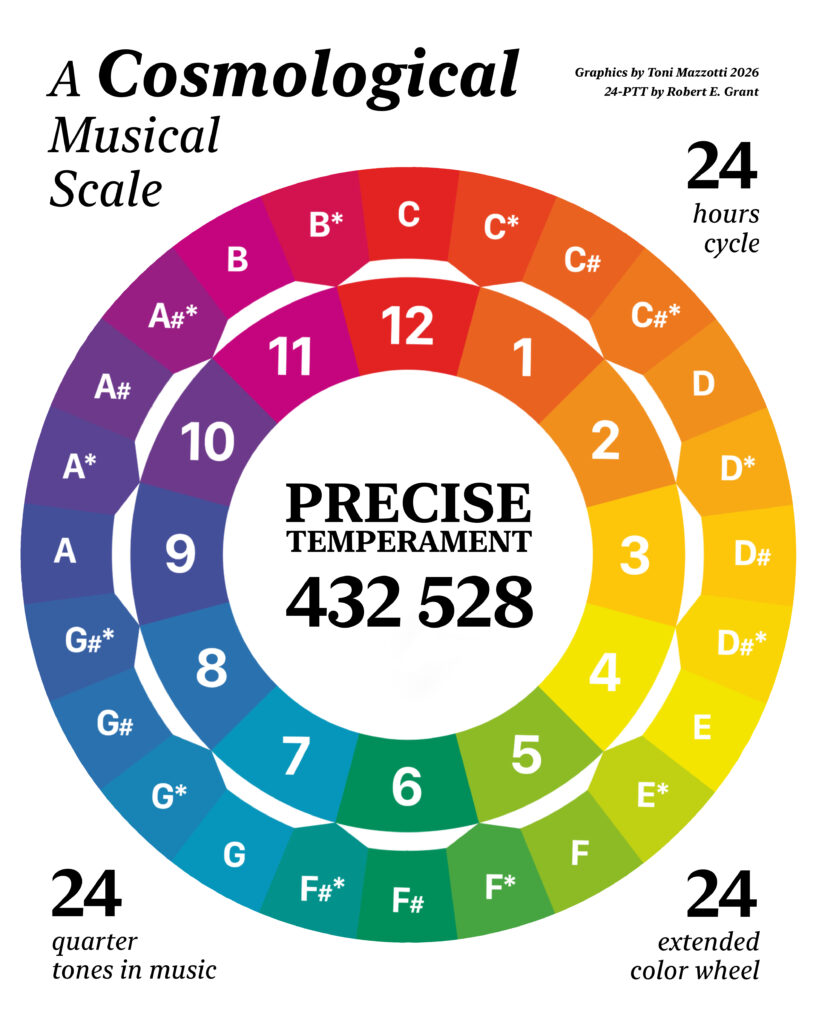
24-PTT Shimmer is a musical tuning system based on 432 Hz and 528 Hz. PTT stands for Precise Temperament Tuning, a cosmological scale that relates the 24 notes to the 24 hours, 24 colors, and 24 chakras. Shimmer is a psychoacoustic phenomenon that had not yet been fully understood, mathematically discovered by Robert E. Grant in 2026 through his analysis of 24-PTT.
– Each note have two frequencies, expanding 24-PTT Shimmer into a 48-note system;
– Creates a sense of luminosity, depth, and motion;
– Produces natural phase modulation and timbral variation;
– Is a monophonic sonic effect that enhances stereo spaciousness;
– Reconciles the Syntonic and Pythagorean commas;
– Resolves the historical dissonance between major thirds and perfect fifths;
– Preserves consonance while avoiding static beating;
– Exhibits identical behavior across all keys and registers;
– Its harmonic consonance emerges naturally from arithmetic;
– Mirrors the structure of atoms, galaxies, and consciousness;
– Encodes electromagnetic, geometric, and musical constants;
– Reflects the duality: masculine and feminine, electric and magnetic, structure and flow;
– 24-PTT is a cosmological scale with 24 notes, 24 hours, 24 extended colors and 24 Chakras;
– 24-PTTS stands for 24 Quarter-Tone Precise Temperament Tuning Dual-Track Shimmer.
“Shimmer opens the sounds incredibly, like a next level
stereophonic sound across dimensions.”
– Robert E. Grant
Bring 432 528 PTT Shimmer
into your Music Production

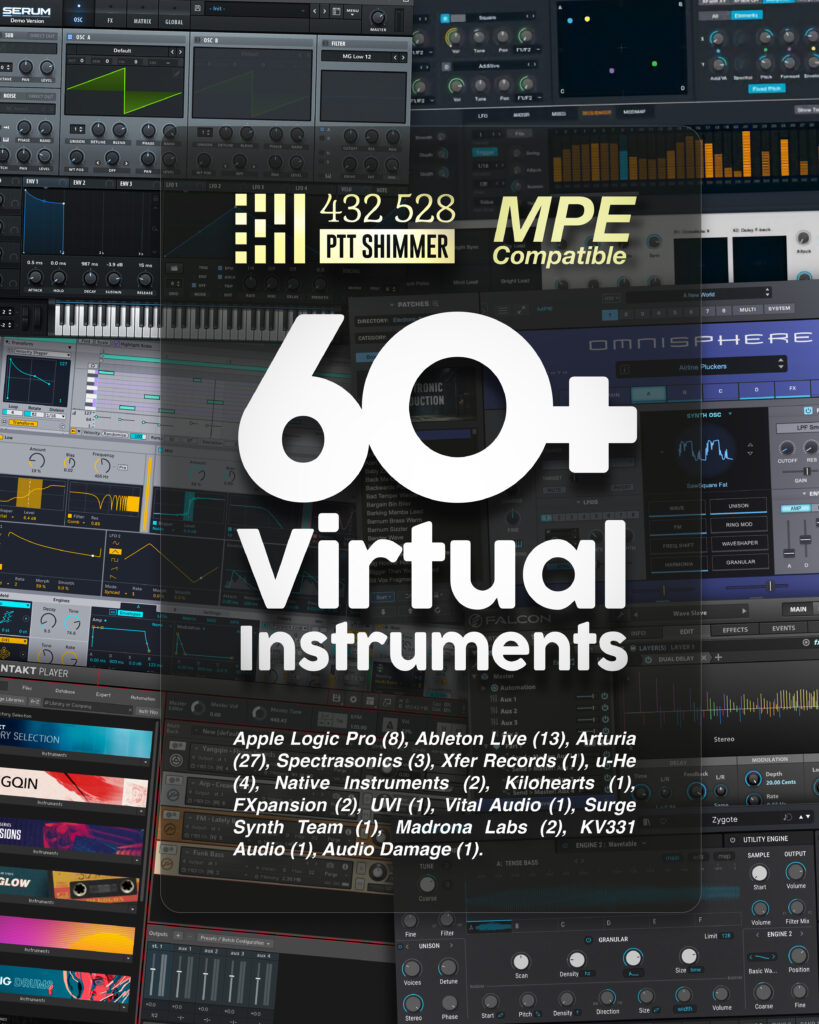

The 432 528 PTT Shimmer Plugin is the easiest and fastest way to tune virtual instruments to Precise Temperament at 432 and 528 Hz, and currently the only way to digitally reproduce Dual-Track Shimmer.
It uses technology originally developed for 432 528 Tunings, the online educational application created by Toni Mazzotti, and now became available for music production in compatible DAWs.
See more here
References
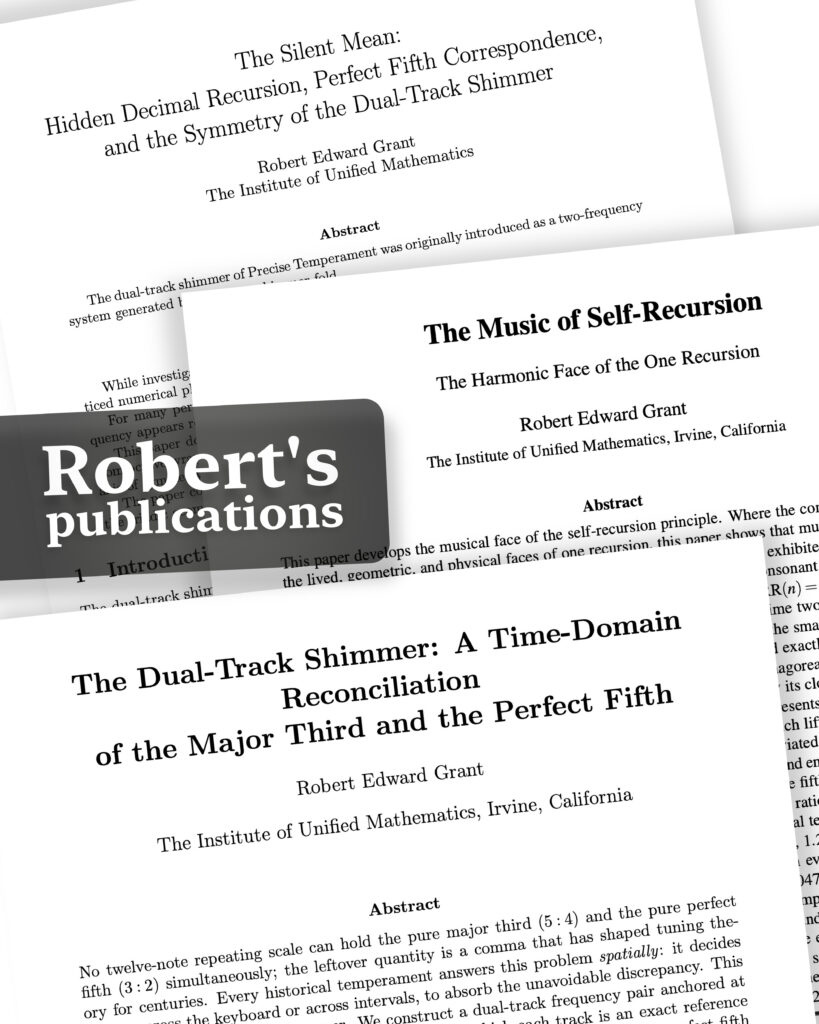
Robert E. Grant’s 2026 research provides a mathematical framework for understanding Dual-Track Shimmer through three papers published by The Institute of Unified Mathematics, Irvine, California:
Music Of Self-Recursion: The Harmonic Face of the One Recursion
The Dual-Track Shimmer: A Time-Domain Reconciliation of the Major Third and the Perfect Fifth
The Silent Mean: Hidden Decimal Recursion, Perfect Fifth Correspondence, and the Symmetry of the Dual-Track Shimmer
In the music-related literature, Shimmer may also refer to:
1. In vocal acoustics
The measurement of small amplitude fluctuations in the human voice, used in voice science and speech-language pathology research. The primary reference is Principles of Voice Production (Ingo R. Titze, 1994).
2. In audio processing
An artificial audio effect that combines reverb and pitch shifting. It is commonly used in ambient music, film scores, and guitar processing. The effect was popularized in the 1980s by Brian Eno and later implemented by manufacturers of digital effects processors.
3. In psychoacoustics and speech processing
An academic reference is Speech Processing (Aalto University), which discusses shimmer as one of the acoustic parameters associated with the perception of roughness, breathiness, and the subtle fluctuations naturally present in human voices and other acoustic sounds.
4. In musical performance
Large choirs, string ensembles, gamelan orchestras, pianos, celeste organ stops, musette accordions, double-reed harmoniums, and other instruments that naturally produce multiple nearly identical frequencies for the same note may generate a perceptible shimmering effect. In this context, shimmer refers to the psychoacoustic interaction between nearly identical monophonic sound sources sounding in unison.